Mr. Merz’s missed opportunity
On August 13, 2025, the German Chancellor organized, conferred, and met, which was necessary and hopefully positive for Ukraine.
Unfortunately, the one image that would have impressed the whole world was missing. No Moscow trolls could have matched the effect.
The image would have shown him and President Zelensky laying flowers at the Berlin Wall Memorial and Checkpoint Charlie, whose construction began in the early hours of August 13, 1961, cementing the separation of the Soviet-occupied eastern part of Germany from the free western part for 45 years.
President Zelensky would certainly have liked the reminder of President Kennedy’s speech in 1963 at the Berlin Wall, where he forsaw the fall of the iron curtain, not of building-up a new one in 2025.
__________________________________
Can we learn from history?
Can we learn from history? Of course we can, if we make the effort to understand and describe history as something created by people. Events do not follow each other as causal sequences, but people act, with similar or opposing interests. People support them or fight them.
Russia’s invasion of Ukraine on February 24, 2022 was unprovoked and well prepared. The conquest of the Crimean peninsula was the test run with “little green men.”
The states of the European Union and the other NATO states clung to the idea of peace in prosperity and did not want to imagine that anyone in the rules-based order after the fall of the Iron Curtain in 1989 would play handball on a soccer field according to the rules—the goals were bigger, after all, as long as the other players did not sanction it.
At present, the appetite to use a rule-based image to return to the idealized, conformist world of soccer, with big goals and deals for friends and relatives, is so great that the rules are retroactively suspended for one team for one season in the first half. –
The goals scored in violation of the rules should nevertheless remain valid if only for the second half, provided that the rules of soccer are observed and there is an intention to comply with them and not simply play handball on the soccer field. . . –
After this promise was made, everyone returned to their seats in the stands and handed out grades with a self-proclaimed level-headedness and objectivity, the contents of which no one really has complete information about. – That’s the picture. –
If it is true that there is a consensus among the member states of the European Union (except for the Hungarian and Slovakian leadership) that Ukraine should not be required to cede any territory, then this idea, which is propagated by others as the only way to achieve peace, should not be repeated without making the consequences clear.
The Russian aggressor’s desire to permanently (the occupation of Germany lasted from 1945 to 1990) cede important locations of Ukrainian industry shows the intellectual emptiness of such thought experiments. –
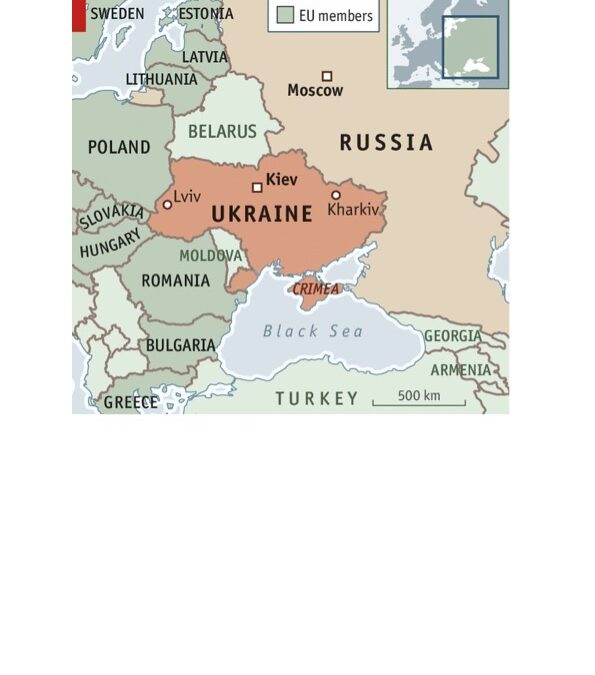
The territories demanded by the aggressor range from Crimea, with its rich coastal deposits of natural gas and oil and its strategically irreplaceable access to mining in the Donets Basin with its strategic raw materials, which the American president and his oligarch business partners want to share with the Russian aggressor Putin and his oligarch business partners. This also involves energy, with Europe’s largest nuclear power plant near Zaporizhzhya, and finally the aerospace industry in the city of Dnipro, with a population of 1 million, less than 40 km from the Russian desired border of the Zaporizhzhya administrative district. –
Since the first draft of a raw materials deal by the new US government provided for the “takeover” of the power plant near Zaporizhzhya by the US oligarchs, the intention to keep Ukraine dependent in the long term has been declared, but on the other hand, the jealousy between the two oligarchies is obvious. It should not be forgotten that Russia is already stealing entire harvests from agriculture and valuable raw materials from mining and selling them on the world market, or using them in its own arms production, such as the rich titanium deposits in the occupied territories of Ukraine, which are unique in Europe. https://europa-information.eu/en/is-the-invasion-of-ukraine-profitable-for-putin-and-his-oligarchs/
These losses, which are potentially painful for Ukraine and life-threatening for its reconstruction, could be explained by historical precedents if there were not two fundamental differences from post-war Germany after the war started and lost by Nazi Germany:
- Germany was the defeated aggressor. Ukraine neither started nor provoked the war. The American appetite for business, “deals,” and exploitation of Ukraine’s natural resources are neither sufficient nor legitimate reasons.
- Numerous cases of war crimes and crimes against humanity have been documented from the years of occupation of the Crimean peninsula since 2014 and the territories in northern Ukraine that were first conquered and then lost, and finally from the territories in eastern Ukraine that are still occupied.
Almost 20,000 child abductions have been verified, with the estimated number exceeding 30,000. The first children are already being offered in an online catalog. There is no reason to believe that this ethnic cleansing would end in the event of a ceasefire.
The return of all Ukrainian children is therefore rightly a Ukrainian precondition for a ceasefire, let alone a peace agreement.
https://www.icc-cpi.int/fr/defendant/vladimir-vladimirovich-putin
https://x.com/adnashmyash/status/1570791376769658882
https://x.com/adnashmyash/status/1953565714931224906
Ukrainian children are being presented online like products.
The Russian occupation administration has published a disturbing online catalog of abducted Ukrainian children, which is openly available on the internet. These children are presented like products in an e-commerce store and can be sorted by age, gender, eye and hair color, health status, and even personality traits.
Their faces are visible in clear, unpixelated photos, with no indication that their legal guardians have given their consent for this sensitive information to be shared. This is not a new tactic.
Ukrainian children have been appearing in Russian adoption databases since 2014. However, since 2022, this practice has become widespread and systematic. Initially, Russian authorities attempted to cover their tracks by closing registries and deleting references. Now there are no more pretexts. It cannot be denied that their publication is being used as a means of exerting time pressure on Ukrainian relatives.
The official website of the so-called “ministry” of the Luhansk occupation administration displays this data openly for all to see. These children are not “war orphans.” They had names, families, and Ukrainian citizenship. Many lost their parents to shelling. Others were forcibly abducted and re-registered with new documents. Now they are being matched with Russian families and treated like animals in a pet adoption database.
This is not adoption. This is not welfare. This is digital child trafficking. President Putin shows no willingness to return these children – but he is eager to exploit them for “commercial purposes.” He has simplified the adoption process so drastically that a Ukrainian child can now be “ordered” online. With a single click, a child is stripped of their identity, issued a Russian passport, and subjected to ideological control. Worse still, this platform exposes children to grave dangers, including:
- Sexual and labor exploitation
- Human trafficking – Illegal adoption
- Forced changes to their name, nationality, language, and cultural identity
- Lifelong psychological trauma
- Possible exploitation for the purpose of organ harvesting
The website has been archived by the Ukrainian authorities and the entire database has been secured. They are working to identify every child listed so that they can be brought home.
Memories of the Soviet occupation zone in post-war Germany
The idea of “territorial cessions” as a reward for a war of aggression contrary to international law should have been ruled out since the “Nuremberg Trials” with the charge of war of aggression based on the Briand-Kellogg Pact, which Germany had signed. It is also not surprising that the Soviet Union had also signed the treaty, which means that Russia, as its legal successor, is bound by this obligation.
https://en.wikisource.org/wiki/Kellogg%E2%80%93Briand_Treaty
Even the word games and sophistry about a “de facto” and only “temporary cession,” as recently formulated in an uncoordinated manner by the NATO Secretary General, do not stand up to scrutiny in light of the experiences in the Soviet occupation zone in postwar Germany.
In the following, based on the experiences of the Moscow occupation in the former GDR, we will take a look at the prospects that the Russian occupation zone would face or is already suffering today.
Freedom of Press and prohibition of torture
Journalist Viktoria Roshchynia dies as a result of Putin’s torture system in the occupied territories.
Journalist Viktoria Roshchynia was researching Putin’s torture prisons in the occupied part of Ukraine. She was imprisoned and died. Her body shows signs of torture.
Ukrainian journalist Viktoria Roshchynia wanted to document torture – and became a victim herself. Research into a harrowing fate in Russian custody.
She wanted to investigate the dark places of Russian occupation and did not return alive. Viktoria Roshchynia was searching for Putin’s torture chambers in Russian-occupied eastern Ukraine. In the process, she herself was abducted, imprisoned, and apparently tortured. On February 14, 2025, her badly decomposed body was handed over to Ukraine.
The body was handed over frozen, with late postmortem changes in the form of pronounced dehydration (mummification), decay, partial detachment of the epidermis, and weight loss with pronounced signs of malnutrition.
According to the Ukrainian prosecutor’s office, her body showed numerous signs of torture and abuse. Investigators say her hyoid bone was broken and she had burns on her feet. Her brain, eyes, and parts of her larynx had been removed by the Russian side. This may make it much more difficult to prove torture.
All these facts would become inner-russian business in case of territorial cessions.-
Precedent set by Moscow’s behavior
Anyone who wants to dismiss the crimes and war crimes described as acts committed by subordinates in the heat of war must be reminded of the behavior patterns of the Moscow occupying power in East Germany.
The attitude of the former German federal government, which can only be understood in the context of former Chancellor Olaf Scholz’s frequent trips to the GDR before the fall of the Berlin Wall, also remains unforgotten.
The following examples show that memories of the occupation experience in East Germany call for particular vigilance in negotiations, first on a ceasefire and then, even more so, on peace negotiations:
Soviet blockade of Berlin and American-British airlift
For a contractual ceasefire solution that would not be limited in time and, even more so, a final peace solution in Ukraine, we must remember the Berlin Blockade and the necessary airlift from June 1948 to October 1949.
Stalin ordered the Berlin Blockade in 1948/49 because his influence over Germany as a whole was in danger of waning after the currency reform. His goal was to literally starve West Berlin into submission, so that it would be abandoned, or so that the Western Allies would grant Moscow a say in the organization of life in post-war Germany as a whole. This desire to determine Ukraine’s internal affairs from Moscow, including the timing of a ceasefire or peace agreement, was Moscow’s goal then and remains so today.
Who still remembers the fact that during the Berlin blockade, every sack of flour, every sack of coal for 2 million people had to be flown from the western occupation zones to the western part of Berlin for 400 days, summer and winter? All land, rail, and water routes from the western occupation zones of Germany to Berlin had been blocked by Moscow.
https://www.alliiertenmuseum.de/en/thema/the-berlin-airlift-1948-49/
Whoever rejects the comparison between the Berlin blockade and the situation in Ukraine after the conclusion of a ceasefire should provide an unbreakable guarantee (not a promise or pledge) that Putin’s Russia would under no circumstances establish a naval blockade of the coast off Odessa between Olenivka on the western tip of the Crimean Peninsula (which would then be under Russian rule by treaty) and the Danube Delta. Would a de facto breach of the ceasefire by the Western guarantor powers then really be conceivable and likely? Or would the mouthpieces of Putin’s Russia in Western democracies reject such a suggestion? The result would be the slow suffocation of Ukraine as a landlocked country without access to the Black Sea. https://europa-information.eu/en/of-ground-troops-and-maps/
Liberation attacks by Ukraine on Russian positions in Crimea would then no longer be possible.
1953 – Workers’ uprisings in the GDR
The workers’ uprising throughout the GDR in 1953 shows particularly clearly what a Russian occupation of the eastern part of Ukraine would mean. It was the first uprising against oppression and exploitation in the new post-war Moscow empire, which was of course designed and decided in Yalta without the participation of the affected states and populations.
“Reparation payments” were made in part by dismantling industrial facilities or by arbitrarily setting prices for industrial goods and raw materials to be delivered, as is already happening in the mines and agriculture of eastern Ukraine.
Extortionate coercion of workers and their families to cooperate in the rearmament or dismantling of industrial facilities. Compulsory military service on the Russian side.
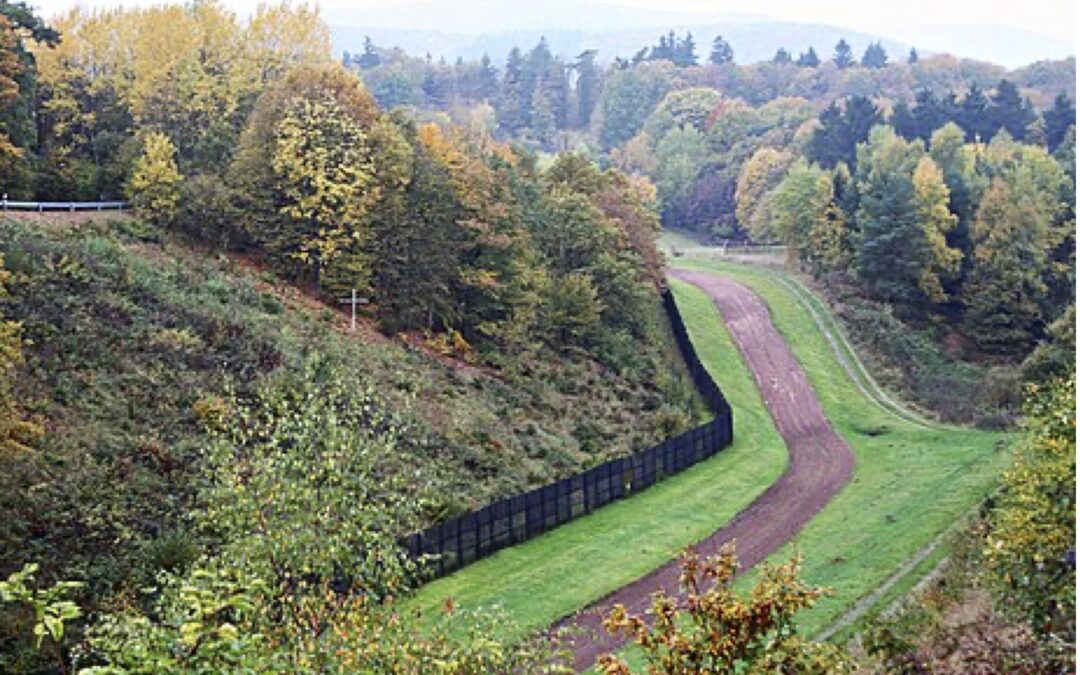
Obstruction of departure or escape by fortified demarcation lines with barbed wire, watchtowers, and mine belts. As in the GDR, the border fortifications would be justified as an “anti-capitalist protective wall” or as a “protective wall against NATO.” Then, as now, there would be no explanation for the inward-facing staggering of the fortifications.
These are not ghosts, but a description of the situation in the Soviet-occupied GDR, which led to workers’ uprisings throughout the GDR in 1953, not only in Berlin. They were crushed by Russian tanks.
Many people’s response to this situation is to flee. In 1952, 182,393 people leave the GDR; a year later, the number of refugees rises to around 331,300. There are also short work stoppages and protests. Finally, on June 17, 1953, the people of the GDR revolted against the SED regime.
Increase in work quotas
The SED regime blamed the deterioration of the economic situation on “class enemies” and “saboteurs.” Extensive measures were taken against alleged “economic criminals.” In May 1953, the SED leadership increased work quotas by 10 percent in order to boost labor productivity. Wages, however, remained the same.
Oppression
Resistance to the “establishment of socialism” or, in the case of the eastern territories of Ukraine, to “Russification” was suppressed. Between mid-1952 and mid-1953, the number of prisoners in GDR prisons doubled to around 66,000.
Watchtowers, landmines, and barbed wire were installed in Berlin and along the western borders of the occupation zone in eastern Germany to prevent citizens from fleeing from east to west, as would also be the case between the free part of Ukraine and the occupied part. On August 13, 1961, the Wall was erected to prevent “flight from the republic.” https://en.wikipedia.org/wiki/Republikflucht
No one is fooled by the autonomous status of the Russian-occupied eastern zone of Ukraine. In the “German Democratic Republic” in the east, every level of government was controlled by Moscow. One of these controllers was Putin himself in Dresden from 1985 to 1990. https://www.bbc.com/news/magazine-32066222
We must never forget: the ceasefire in Germany lasted 45 years, from 1945 to 1989. During this time, “only” those who tried to flee to freedom were killed. They were shot while attempting to escape the republic, drowned while swimming to freedom in canals and rivers, or injured and sentenced to long prison terms. We must also never forget those whose lives and health were destroyed in Stasi prisons, who were banned from studying at universities. Nor can we forget the school classes and church communities in the West who identified trustworthy and courageous individuals in the East and sent them parcels containing chocolate and other Christmas or Easter gifts.
A meeting of the German chancellor in Berlin on August 13 at the monument to the construction of the Wall, together with the president of the very nation and people that wants to be free and self-determined, not even partially occupied, would have sent a clear message to Washington.
Autocratically inspired leaders in Budapest and Bratislava would inevitably have been reminded that Russian tanks bloodily ended the self-determination of Hungary in 1956 and Slovakia in 1968.
Both member states of the European Union would have a common border with Russia in the event of Ukraine’s defeat. In the best-case scenario, the well-known threats and intimidation would threaten the sovereign freedom of action of both countries. In the worst-case scenario, the Suwałki Corridor on the Lithuanian-Polish border will be the least of their problems, especially when you consider Austria’s neutrality and the topography of the Alps. Are Ukrainians fighting for Europe? Of course they are. They are even fighting against the sweet poison of surrender to corrupt leaders in Hungary and Slovakia.
Chancellor Merz and President Zelensky could have remembered and reminded the whole world about President John F. Kennedy’s speech in 1963 at that same Berlin Wall built in 1961. His words of the world after war and iron curtain are today as true as they were then:
“Freedom has many difficulties and democracy is not perfect, but we have never had to put a wall up to keep our people in, to prevent them from leaving us. I want to say, on behalf of my countrymen, who live many miles away on the other side of the Atlantic, who are far distant from you, that they take the greatest pride that they have been able to share with you, even from a distance, the story of the last 18 years (1963). I know of no town, no city, that has been besieged for 18 years that still lives with the vitality and the force, and the hope and the determination of the city of West Berlin. While the wall is the most obvious and vivid demonstration of the failures of the Communist system, for all the world to see, we take no satisfaction in it, for it is, as your Mayor has said, an offense not only against history but an offense against humanity, separating families, dividing husbands and wives and brothers and sisters, and dividing a people who wish to be joined together.
What is true of this city is true of Germany — real, lasting peace in Europe can never be assured as long as one German out of four is denied the elementary right of free men, and that is to make a free choice. In 18 years of peace and good faith, this generation of Germans has earned the right to be free, including the right to unite their families and their nation in lasting peace, with good will to all people. You live in a defended island of freedom, but your life is part of the main. So let me ask you as I close, to lift your eyes beyond the dangers of today, to the hopes of tomorrow, beyond the freedom merely of this city of Berlin, or your country of Germany, to the advance of freedom everywhere, beyond the wall to the day of peace with justice, beyond yourselves and ourselves to all mankind.
Freedom is indivisible, and when one man is enslaved, all are not free. When all are free, then we can look forward to that day when this city will be joined as one and this country and this great Continent of Europe in a peaceful and hopeful globe. When that day finally comes, as it will, the people of West Berlin can take sober satisfaction in the fact that they were in the front lines for almost two decades.
All free men, wherever they may live, are citizens of Berlin, and, therefore, as a free man, I take pride in the words “Ich bin ein Berliner.”
Remarks of President Kennedy Berlin 1963
Indeed, the joint commemoration by Chancellor Merz and President Zelensky on August 13th at the Berlin Wall Memorial would have been a good opportunity to force the freedom-loving world to understand, that a new iron curtain is not an option.
Rather should we look far beyond fiscal years and election cycles and understand that we as Europeans should be in our historic experience and in our hearts’ aspirations – Ukrainians! TH